
Independent Field Trial: AgroComplex for Potato Yield Enhancement
- 17 August 2026
- Paul Daly
Field-Tek Trial Reference: EM25106
Crop: Potatoes (Solanum tuberosum)
Trial Year: 2026
Independent Trial Provider: Field-Tek Research Services
Sponsor: EMNZ
Executive Summary
An independent replicated field trial was conducted by Field-Tek Research Services to evaluate the efficacy and crop safety of AgroComplex when applied to potatoes under commercial field conditions.
The trial was independently established, managed, assessed and analysed by Field-Tek using a randomised replicated trial design with four replicates per treatment. This report focuses specifically on the comparison between AgroComplex at 15 L/ha and the untreated control.
The original independent trial protocol specified three foliar applications during crop development. However, the commercial grower desiccated the trial area earlier than anticipated. Consequently, only two of the three planned applications could be completed and the final foliar assessments could not be undertaken.
Despite the shortened programme, AgroComplex produced a strong numerical yield response. Total harvested tuber weight averaged 5.54 kg per harvest sample compared with 4.37 kg for the untreated control, representing a 27% increase in total yield.
The strongest response occurred in the 100–200 g tuber grade, where AgroComplex produced approximately 3.09 kg per sample compared with 1.87 kg for the untreated control, an increase of approximately 65%.
The yield differences did not reach statistical significance (P>0.05) and therefore cannot be considered a statistically confirmed treatment effect. However, the magnitude of the independently measured yield response, despite only two of the three planned applications being completed, supports further evaluation of AgroComplex in potatoes.
Trial Objective
The objective of the independent Field-Tek trial was to evaluate the efficacy of AgroComplex for enhancing potato crop growth and yield and to assess crop safety when applied under commercial growing conditions.
The Field-Tek protocol specified AgroComplex at 15 L/ha, with treatments planned during flowering, tuber initiation and tuber bulking.
Experimental Design
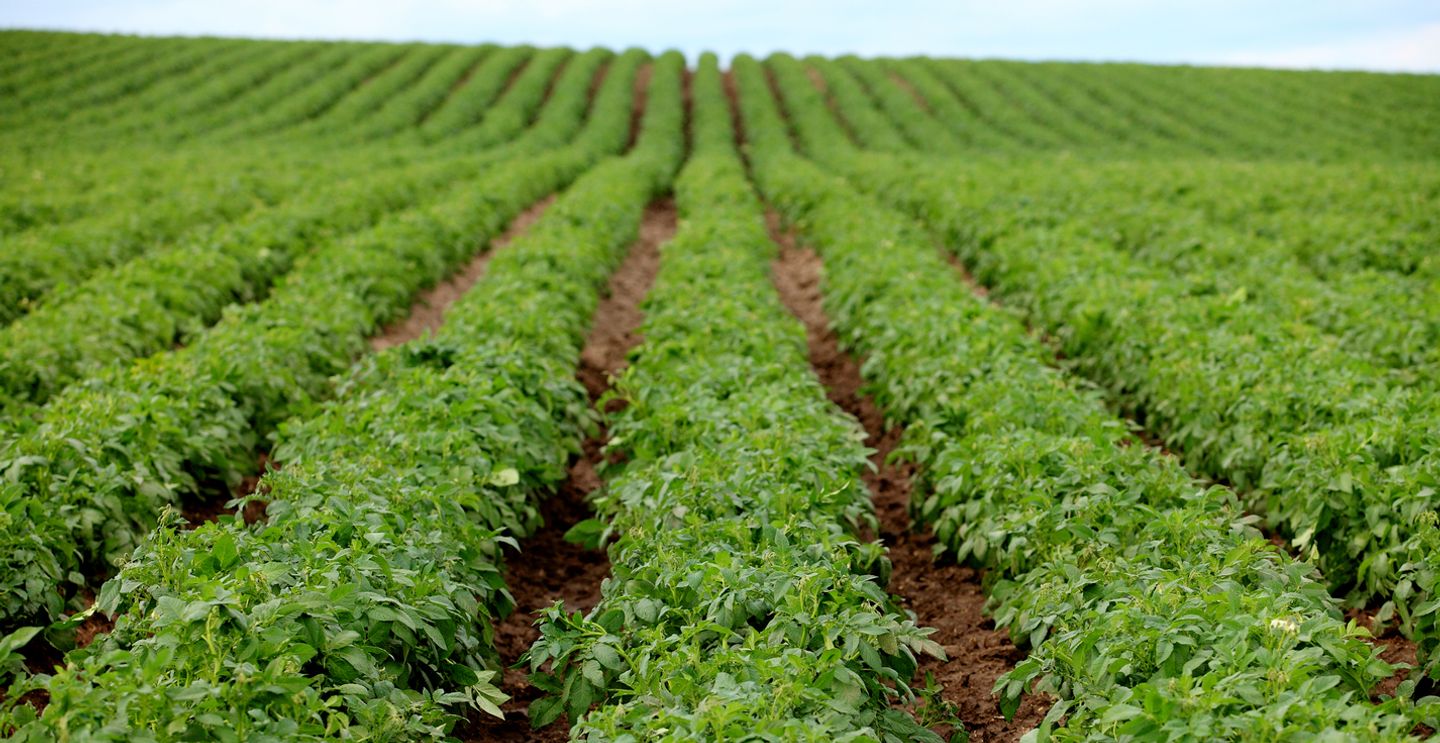
The trial was independently conducted by Field-Tek Research Services using a randomised trial design with four replicates per treatment.
 For the purposes of this report, results are presented for AgroComplex relative to the untreated control.
| Treatment | Application Rate |
|---|---|
| Untreated Control | – |
| AgroComplex | 15 L/ha |
The protocol specified an application water rate of 200–400 L/ha.
Application Programme
Three applications were originally planned:
- Flowering
- Tuber initiation
- Tuber bulking
Only the first two applications were completed.
Before Application C and the subsequent foliar assessments could be undertaken, the commercial grower desiccated the trial area along with the remainder of the paddock. Field-Tek subsequently proceeded with the harvest and harvest assessments.
This deviation from the original protocol is important when interpreting the results. AgroComplex received only two of the intended three applications, with the final planned application during the important tuber-bulking period unable to be completed.
Crop Growth and Safety
No treatment-related phytotoxicity was observed following AgroComplex application.
Field-Tek's crop assessments showed broadly comparable crop vigour, biomass and NDVI between AgroComplex and the untreated control.
| Assessment | Untreated Control | AgroComplex |
| Vigour – 20 February | 8.3 | 7.8 |
| Biomass | 85.0% | 81.3% |
| Vigour – 3 March | 7.8 | 7.8 |
| NDVI | 0.905 | 0.888 |
There were no statistically significant differences in these vegetative measurements.
The absence of treatment-related phytotoxicity indicates that AgroComplex at 15 L/ha was crop safe under the conditions of this independent trial.
Harvest Results
Total Tuber Yield
At harvest, Field-Tek recorded an average total tuber weight of 4,367.8 g per sample from the untreated control compared with 5,540.3 g per sample from AgroComplex.
| Treatment | Total Yield | Difference vs Control |
| Untreated Control | 4,367.8 g | – |
| AgroComplex | 5,540.3 g | +26.9% |
AgroComplex therefore produced approximately 1.17 kg additional tuber weight per harvested sample, representing a 27% numerical increase in total yield over the untreated control.
Tuber Size Distribution
 The strongest response was observed within the 100–200 g tuber category.
| Tuber Grade | Untreated Control | AgroComplex | Difference |
| 100–200 g tuber number | 12.5 | 21.5 | +72% |
| 100–200 g tuber weight | 1,871 g | 3,092 g | +65% |
| 200–300 g tuber number | 3.8 | 5.3 | +40% |
| 200–300 g tuber weight | 895 g | 1,188 g | +33% |
| >300 g tuber number | 2.3 | 1.0 | – |
| >300 g tuber weight | 829 g | 371 g | – |
AgroComplex substantially increased both the number and weight of tubers within the 100–200 g grade.
The AgroComplex treatment produced an average of 21.5 tubers per sample compared with 12.5 in the untreated control, representing approximately 72% more tubers in this grade.
Yield within the 200–300 g category was also numerically higher, with AgroComplex producing approximately 33% greater tuber weight than the untreated control.
The results therefore indicate that the overall yield response was primarily associated with increased production of tubers within the 100–300 g size range, rather than increased production of very large tubers.
Statistical Interpretation
The independently analysed treatment differences did not reach statistical significance at the 5% level (P>0.05).
The observed yield increases should therefore be interpreted as positive numerical trends rather than statistically confirmed treatment effects.
Several factors should be considered when interpreting this result. The trial had four replicates per treatment and was conducted within a commercial potato paddock where natural spatial variability can influence yield.
More importantly, the trial could not be completed according to the original protocol. The planned third AgroComplex application during tuber bulking was not applied because the grower desiccated the trial area prematurely.
The shortened programme potentially reduced the opportunity for treatment differences to fully develop before harvest.
Discussion
The independent Field-Tek trial identified a substantial numerical yield response to AgroComplex.
Following two applications, total harvested tuber weight increased from 4.37 kg per sample in the untreated control to 5.54 kg with AgroComplex, representing an approximately 27% increase.
The distribution of this additional yield is particularly interesting. AgroComplex produced approximately 65% greater tuber weight and 72% more tubers within the 100–200 g grade than the untreated control.
AgroComplex also produced approximately 33% greater tuber weight within the 200–300 g grade.
This indicates that the overall yield response was associated primarily with increased production of medium-sized tubers rather than a small number of oversized tubers.
The lack of statistical significance means that the response cannot be conclusively attributed to AgroComplex from this trial alone. Nevertheless, the magnitude of the independently measured numerical response is agronomically noteworthy.
Importantly, the response occurred despite AgroComplex receiving only two of the three applications specified in the independent trial protocol.
Completion of the intended third application during tuber bulking may have provided greater opportunity for treatment effects to develop, although this cannot be determined from the current trial.
Conclusion
In this independent replicated field trial conducted by Field-Tek Research Services, AgroComplex at 15 L/ha was crop safe and produced no observable treatment-related phytotoxicity.
Following two applications, Field-Tek measured:
- 27% greater total harvested tuber weight with AgroComplex compared with the untreated control.
- 65% greater tuber weight in the 100–200 g grade.
- 72% more tubers in the 100–200 g grade.
- 33% greater tuber weight in the 200–300 g grade.
These differences did not reach statistical significance and should therefore be regarded as positive numerical trends rather than statistically confirmed treatment effects.
Interpretation of the trial is limited by the premature desiccation of the trial area, which prevented the third planned AgroComplex application and subsequent foliar assessments from being completed.
Nevertheless, the magnitude of the yield response measured independently by Field-Tek supports further replicated evaluation of AgroComplex using the complete three-application programme.
Key Finding
In an independent replicated field trial conducted by Field-Tek Research Services, two applications of AgroComplex at 15 L/ha produced a 27% numerical increase in total harvested potato yield compared with the untreated control. The strongest response was observed in the 100–200 g tuber grade, with 65% greater tuber weight and 72% more tubers. While these differences were not statistically significant, the planned third application could not be completed due to premature grower desiccation of the trial area.